
Arrest Records in Knox County
Arrest records are made by law enforcement, not by the courts. In Knox County, the Sheriff's Office under Sheriff Tom Spangler books and houses people taken into custody, and the Knoxville Police Department makes arrests within the city. An arrest record marks the moment a person is taken in. It lists the booking date, the charges, and the holding facility. The District Attorney's office then decides how the case proceeds.
An arrest record is not the same as a criminal court record or a conviction. The arrest is the start; the court file holds the charges, motions, and outcome. For the full case history, see the Knox County court records page. This page stays focused on arrests, booking, and how to find recent arrests.
The Knox County Criminal Court Clerk works alongside the Sheriff and the District Attorney once a case is charged.
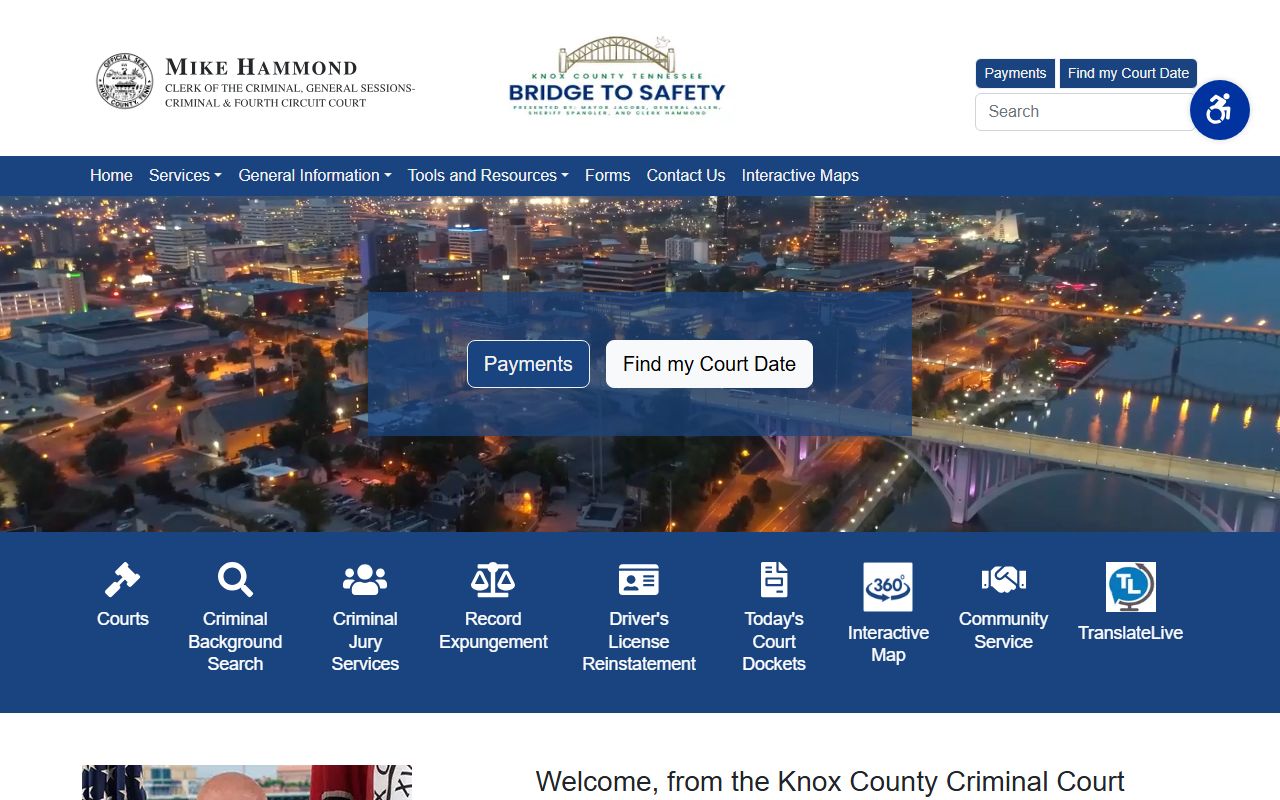
The clerk's office files and preserves records for Criminal Court, General Sessions-Criminal, and Fourth Circuit.
How to Search Knox County Arrest Records
The fastest public route to recent arrests is the Sheriff's online lists. The 24-hour arrest list shows people booked or held within the recent window, and the current inmate population list shows everyone in custody now. Both are free. For a deeper local history, the Criminal Court Clerk sells a background package that covers Knox County and Knoxville charges dating back to the 1980s.
- Open the Sheriff's 24-hour arrest list to see recent bookings.
- Check the current inmate population list by first and last name.
- For a local name history, buy the Criminal Court Clerk's background package.
- For statewide history, use the TBI background check service.
Statewide criminal history comes from the Tennessee Bureau of Investigation, which is a separate product from the local clerk package and the Sheriff's roster.
Arrest Records vs. Criminal Court Records
An arrest record is created at booking. A criminal court record begins when charges are filed and a case is opened. They come from different offices, and they hold different things. The table below lays out the split.
| Arrest Record | Criminal Court Record | |
|---|---|---|
| Source | Knox County Sheriff / Knoxville Police | Criminal Court Clerk |
| Created When | Booking and intake | Charges filed |
| Contents | Booking date, charges, bond, holding facility | Pleadings, motions, disposition, sentence |
The clerk's office explains its own role on its about page.
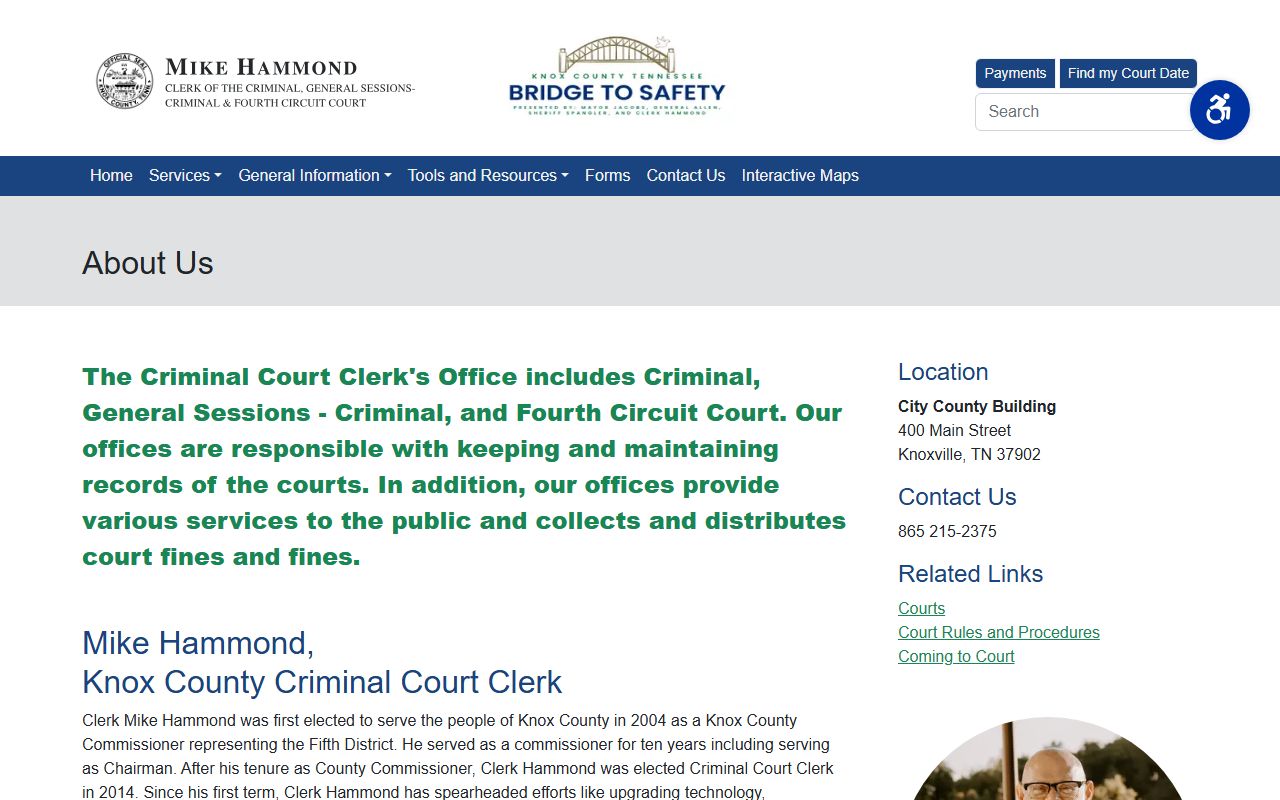
The Criminal Court Clerk about page describes Court Operations, Finance, and Community Services, including expungement screenings.
Charges vs. Convictions
Being charged is not the same as being convicted. A charge is an accusation that rests on probable cause. A conviction is a verdict or a guilty plea decided beyond a reasonable doubt. The District Attorney's Criminal Justice 101 guide explains that Knox County cases begin in General Sessions and that five magistrates set bonds and sign warrants.
| Charge | Conviction | |
|---|---|---|
| Stage | Accusation | Verdict or plea |
| Burden of Proof | Probable cause | Beyond a reasonable doubt |
| Public Record | Yes | Yes |
The clerk's court page lists the Criminal Court judges and the General Sessions-Criminal divisions that handle these stages.
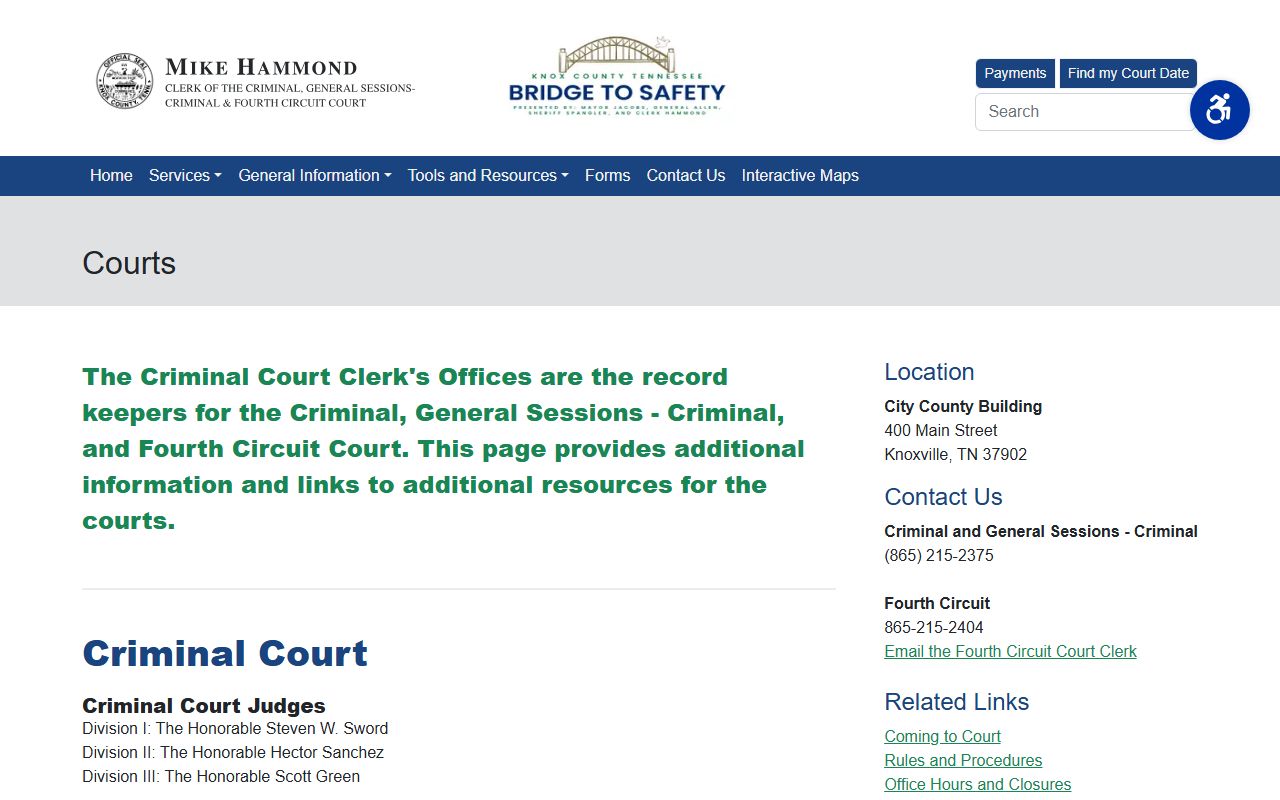
The Criminal Court Clerk court page also lists specialty courts and the child support office.
Sealed vs. Expunged Records
A sealed record is hidden from public view but still exists. An expunged record is removed and treated as though it never happened. In Tennessee, expungement starts in the court where the case began. Dismissed charges, a no true bill, a not-guilty verdict, an arrest without charges, and nolle prosequi cases may qualify at no cost. Diversion and some convictions can carry a fee.
| Sealed | Expunged | |
|---|---|---|
| Visibility | Hidden from the public | Removed and destroyed |
| Law Enforcement | Limited access | Very limited |
| Eligibility | By court order or statute | Dismissals, no true bill, acquittals, eligible cases |
The Tennessee Administrative Office of the Courts hosts the official expungement guidance, which links to Tenn. Code Ann. § 40-32-101.
Mugshots and Booking Photos
Booking photos are part of the arrest record at the jail. The Sheriff's inmate and 24-hour lists are the official source for current custody, and a photo may appear on a profile when the page is viewed in a browser. Knox County publishes its roster as a public service and warns that the data should not be relied on for legal action. Avoid private mugshot sites, which often charge to remove photos and are not official.
Statewide Criminal Records Search
A local arrest list does not show charges from other counties. For a statewide picture, the Tennessee Bureau of Investigation runs the official background check service through tn.gov. For people who went to state prison, the Department of Correction's Felony Offender Information Lookup, known as FOIL, shows status, location, offense, and sentence. These are separate from the Knox County clerk's local package, which covers only Knox County and Knoxville charges.
Background Check Considerations
There is a real difference between a casual public-record lookup and a formal background check used for hiring or housing. Formal checks fall under federal law and must come from a compliant provider. The local clerk package, the Sheriff's roster, and the free portals are public-record tools, not consumer reports.
Important: This site is not a consumer reporting agency, and its information cannot be used for credit, employment, tenant, or insurance decisions under the FCRA.
Restricted Criminal Records in Knox County
Some criminal records are not open. Juvenile records are private under Tennessee law, with few exceptions. Sealed records and files under a protective order need a court order to view. Active investigation records may be held back while a case is open. If a record was expunged, it should no longer appear in public results, and the order is sent to the arresting agency, the county jail, the Department of Correction, and the TBI.
The Knox County Criminal Process
Knox County criminal cases move through a three-stage Tennessee process that begins in General Sessions Court. An arrest can start with an officer who witnesses a crime, a misdemeanor citation, or a criminal summons that a victim asks a magistrate to issue. For a felony, an officer may arrest on probable cause even when the crime did not happen in the officer's presence. For a misdemeanor the officer did not witness, the officer usually must get an arrest warrant first.
General Sessions splits into divisions. First Sessions hears misdemeanors, Second Sessions hears DUI, Third Sessions hears felonies, and Fourth Sessions hears traffic and bonded arraignment. From there a felony can go to the grand jury and then to Criminal Court for trial. Reading the division on a record tells you which track a case is on.
Local Criminal Background Packages
The Criminal Court Clerk sells a local background package as a community service. It costs $15 and includes three searches: a first and last name search, an alias first and last name search, and a Social Security number search. Each extra alias is $5. The package covers Knox County and Knoxville charges dating back to the 1980s.
This local package is not a statewide check. It will not show charges from other Tennessee counties, state prison records, or federal cases. For a wider search, use the TBI statewide background check, TDOC FOIL for state custody, or the Bureau of Prisons locator for federal inmates. Keep these tools separate, because each one answers a different question.