
How to Search Knox County Court Records
The main free tool for Fourth Circuit and General Sessions cases is the OnBase Public/JIMS party search. It lets you look up a case by last name, first name, or case title when you do not know the docket number. Once you have a docket number, the Hyland eCommerce portal pulls documents for Fourth Circuit and General Sessions. Civil Circuit and Civil Sessions filings live in a separate subscription service called KnoxCircuit Records.
Before you start, gather a full name, an approximate filing date, and the court type. Knowing whether your matter is criminal, civil, domestic, or equity saves a lot of dead-end searches. The eCommerce page itself links back to the JIMS party search with the prompt "Don't know the Docket Number? Click here to find it by party name."
- Decide the case type and the clerk that holds it.
- Open the JIMS party search and enter a name or title.
- Filter by court type and the opened-after and opened-before dates.
- Copy the docket number from the result row.
- Use that number in the eCommerce document search, or ask the clerk for a certified copy.
The District Attorney's Criminal Justice 101 guide explains how a Knox County case moves from arrest through General Sessions to Criminal Court.
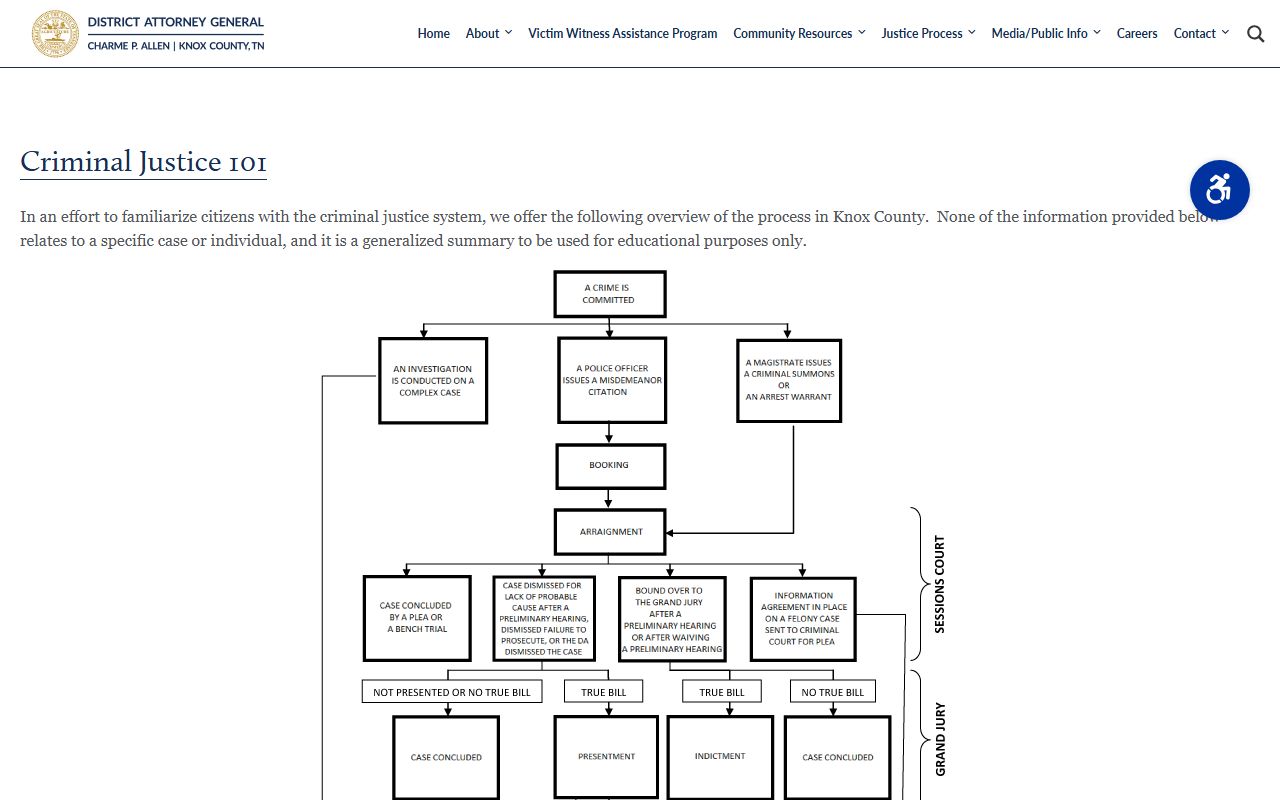
That process is the reason the same person can appear in both General Sessions and Criminal Court record systems.
Knox County Court Records Search Fields
The JIMS party search uses a small set of fields. Name fields match anything that starts with what you type, so a short entry returns a broad list. The case-title field matches any title that contains the value. At least one name or title is required, and the court-type and date filters help you cut down the results.
| Field Label | Type | Required | Notes / Format |
|---|---|---|---|
| Last Name | Text | One name or title | Matches last names starting with the value (SMITH finds SMITHERS). |
| First Name | Text | One name or title | Matches first names starting with the value. |
| Case Title | Text | One name or title | Matches any title containing the value. |
| Role checkboxes | Checkbox | No | Attorney, Defendant, Plaintiff, or Judge. |
| In Court | Radio | No | All, Fourth Circuit, or General Sessions. |
| Opened After / Before | Date | No | Filters by filing date; default may exclude old cases. |
For known docket numbers, the eCommerce search asks only for a product type, either Fourth Circuit Documents or General Sessions Documents, and the docket number itself.
Types of Knox County Court Records
Each Knox County court produces its own kind of record. Criminal Court records hold felony prosecutions, indictments, judgments, and sentencing orders. General Sessions-Criminal records cover misdemeanors, DUI, traffic, and felony preliminary matters. Fourth Circuit records hold divorces, orders of protection, and child custody. Circuit and Civil Sessions records cover civil suits and small claims. Chancery records cover equity, probate, and guardianship.
Knowing which court made the record tells you which clerk to ask and which portal to use.
- Criminal Court and General Sessions-Criminal records, kept by Mike Hammond's office.
- Fourth Circuit divorce and domestic records, also under the Criminal Court Clerk.
- Circuit civil and Civil Sessions small claims records, under Charles D. Susano III.
- Chancery and probate records, under the Clerk and Master.
- Juvenile records, which are private under Tennessee law with few exceptions.
What Knox County Court Records Show
A court record is a set of fields that together describe a case. The JIMS results show the Court, the party Name, the Role, the case Title, the Opened date, and the Docket number. Pull the full file and you can see filings, motions, orders, and the disposition. The fields below are the ones a typical Knox County court record search returns.
| Field | What It Shows |
|---|---|
| Docket Number | The clerk's case identifier; formats vary by court. |
| Opened Date | When the case was filed. |
| Parties and Role | Names with roles such as Defendant or Lead Defendant. |
| Title | Charge description or case caption. |
| Disposition | The outcome of a charge or case. |
A few terms repeat across Knox County files.
- Docket
- The chronological list of events in a case.
- Motion
- A request asking the judge to make a ruling.
- Disposition
- How a charge or case ended.
Public Access Framework for Knox County Court Records
Tennessee starts from a broad right of access, then narrows it for courts. The Public Records Act, Tenn. Code Ann. § 10-7-503, gives the public a right to inspect government records. Court files are governed more closely by Tennessee Supreme Court Rule 34, which defines court records and lists what the public can see. The rule also points to Tenn. Code Ann. § 16-3-401 for reasonable limits that protect the courts' work.
Anyone can search the free public portals. Certified copies and document images may cost a fee or require an in-person request. The Public Defender's Community Law Office is one local resource for people who need help understanding the system.

The Community Law Office represents eligible clients in criminal and juvenile cases and offers a holistic, client-centered model.
Note: Rule 34 begins with a broad access right, but it lists categories that are not public, so not every court record is open to view.
Records That Are Sealed or Confidential in Knox County
Some Knox County court records are closed by law. Juvenile records are private with few exceptions. Adoption records are confidential and run through the Department of Children's Services. Sealed records and files under a protective order are off limits unless a judge orders otherwise. Expunged records are removed once the court grants the petition.
To view a sealed record, a party or attorney usually files a motion with the court that holds it. The clerk cannot release a confidential file on request. Tennessee's expungement process starts in the court where the case began, and the order is then sent to agencies such as the arresting agency, the county jail, the Tennessee Department of Correction, and the TBI.
The full text of the court-access rule sits on the Tennessee courts site.
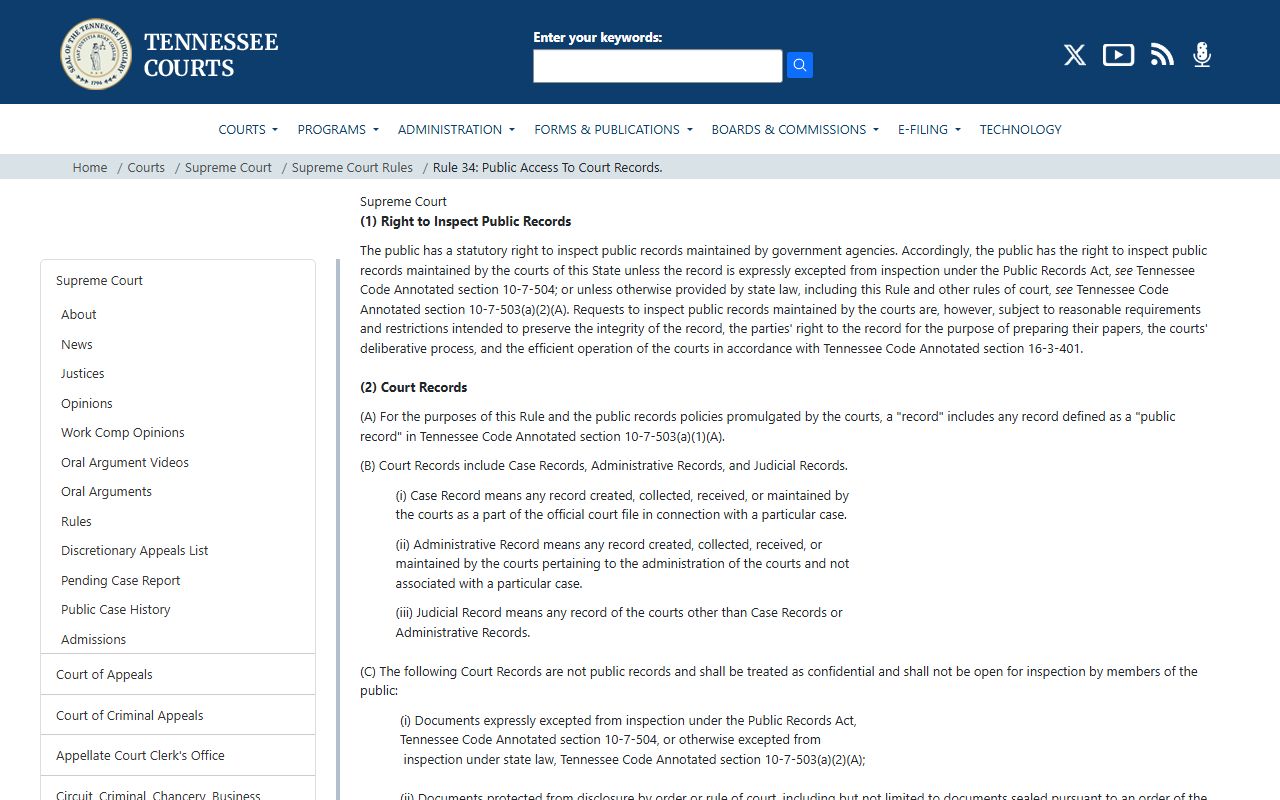
Rule 34 is the controlling source when a Knox County clerk decides whether a record can be released.
In-Person Court Record Requests
When an online search is not enough, you can request records at the clerk's counter. The Criminal Court Clerk handles criminal, General Sessions-Criminal, and Fourth Circuit files. Bring a name, a docket number if you have one, and payment for any certified copy. Hours run Monday through Friday.
Criminal Court Clerk
400 Main Street, Suite 149
Knoxville, TN 37902
865-215-2375
Mon-Fri 8:00 a.m.-4:30 p.m.
Civil Records and KnoxCircuit Subscriptions
Civil Circuit and Civil Sessions filings are not in the free JIMS tool. They run through a paid service called KnoxCircuit Records. A three-month subscription is $120 and a one-year subscription is $480, plus a $2.50 card processing fee. The service covers Circuit records from April 14, 2015 and Civil Sessions records from October 4, 2017, and subscribers can review and copy filings usually within 24 hours of submission.
Chancery records work differently again. There is no free public Chancery case-search form, so equity and probate matters go through the Clerk and Master's office, the Chancery filing and copies pages, or an in-person request. Match the case to the court before you pick a tool.
Certified Copies and Record Fees
A certified copy is the version courts and agencies accept as official; an uncertified print is for reference only. Fees depend on the office. The Criminal Court Clerk's local background package is $15 with extra aliases at $5 each. Card payments to the Criminal, General Sessions-Criminal, and Fourth Circuit offices carry a 2.5 percent service charge plus $0.50. Filing fees for Circuit, Civil Sessions, and Chancery changed on January 1, 2026 under Tenn. Code Ann. § 8-21-401, so check the official PDF schedules for line items.
Note: ask for a certified copy when a record is needed for a legal filing, a name change, or an official request, since an online print may not be accepted.