
Knox County Trial Courts Overview
The Tennessee Constitution divides the state's 95 counties into judicial districts that include Circuit and Chancery courts. Knox County sits in the Sixth Judicial District. Circuit Court is a court of general jurisdiction and can hear appeals from limited-jurisdiction courts. Criminal Court handles felony trials. Chancery handles equity and probate work. General Sessions is the busy lower court where most cases begin, and Juvenile Court handles youth matters.
Most of these courts share one building. The City-County Building at 400 Main Street holds Criminal, Circuit, Fourth Circuit, Chancery, and General Sessions courtrooms and clerk offices. Juvenile Court runs from a separate building on Division Street. The Criminal Court Clerk's visitor page explains where each courtroom sits inside the building.
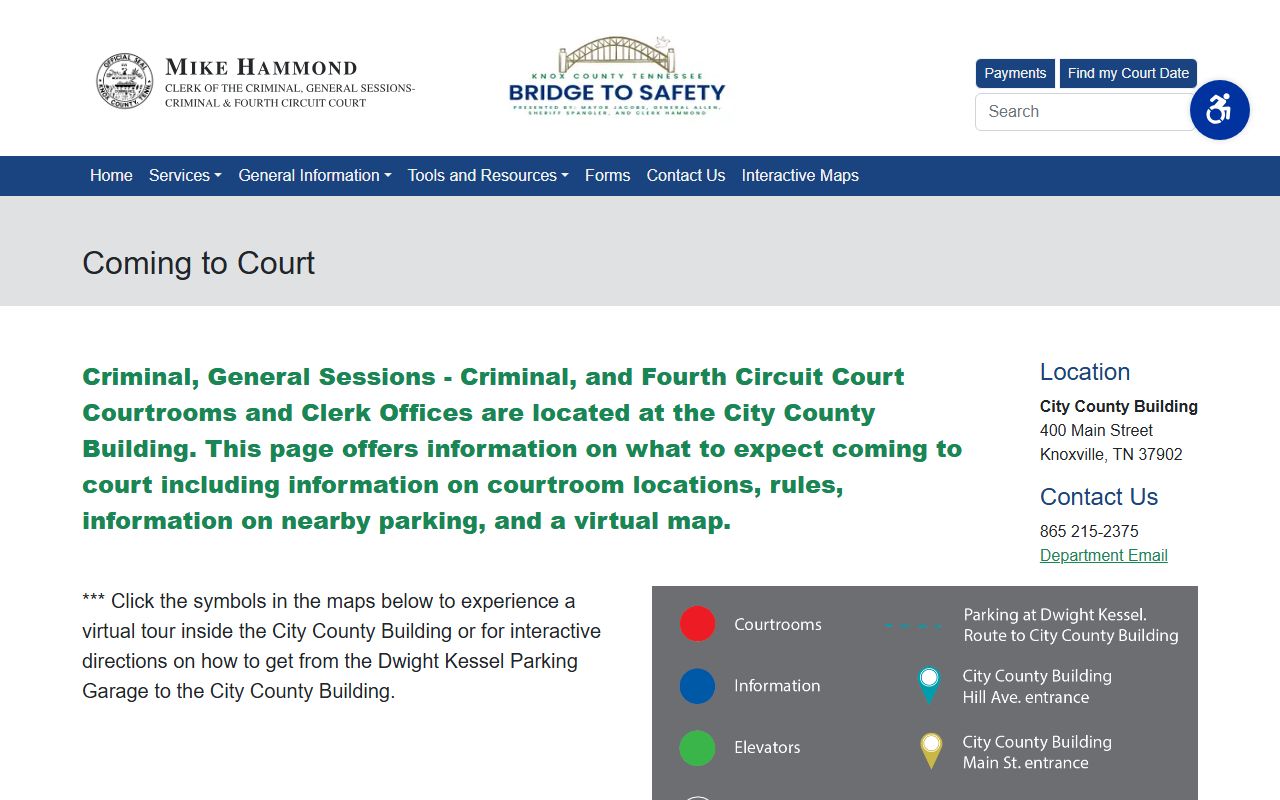
The Coming to Court page covers courtroom floors, parking, the trolley, and accessible entrances at the City-County Building.
The layout inside the building follows the court. Criminal Court Division I and Division II courtrooms are on the first floor, and Division III is on the main floor. General Sessions-Criminal courtrooms are on the main floor, and the Fourth Circuit courtroom and clerk office sit on the east end of the main floor. Knowing the floor matters on a hearing day, because the building holds several courts at once and the entrances and security screening route everyone to the same lobby.
List of Knox County Courts and Judges
Knox County's trial courts divide by subject. Criminal Court runs in three divisions, each with its own judge. General Sessions splits into sessions for misdemeanors, DUI, felonies, traffic, and civil matters. The table lists the main courts, their focus, and their downtown location.
| Court | Division or Focus | Address | Phone |
|---|---|---|---|
| Criminal Court | Div. I Sword, Div. II Sanchez, Div. III Green | 400 Main Street | 865-215-2375 |
| Circuit Court | General jurisdiction, appeals | 400 Main Street, Suite M30 | 865-215-2400 |
| Fourth Circuit | Divorce, protection, custody | 400 Main Street, main floor | 865-215-2404 |
| Chancery Court | Equity, probate | 400 Main Street, Suite 125 | 865-215-2555 |
| General Sessions | Misdemeanor, DUI, felony, traffic, civil | 400 Main Street | 865-215-2375 |
| Juvenile Court | Judge Timothy E. Irwin | 3323 Division Street | 865-215-6400 |
Circuit Court vs. General Sessions vs. Juvenile Court
The trial courts differ by what they can hear and how much money is at stake. Circuit Court is general jurisdiction. General Sessions is limited, with a civil cap and the first stage of criminal cases. Juvenile Court is its own track with restricted records. The table compares the three.
| Circuit Court | General Sessions | Juvenile Court | |
|---|---|---|---|
| Jurisdiction | General | Limited | Juvenile |
| Civil Limit | No fixed cap | Small claims under $25,000 | Not applicable |
| Criminal Role | Felony trials and appeals | First stage, misdemeanors, DUI | Delinquency, unruly |
| Records | Public, by subscription online | Public via JIMS and eCommerce | Private with few exceptions |
How a Case Moves Through the Knox County System
A criminal case usually begins with an arrest or a citation and moves into General Sessions, where five magistrates set bonds and sign warrants. Felonies can go to the grand jury and then to Criminal Court. A civil case is filed in Circuit Court or, for smaller amounts, in Civil Sessions. Appeals leave the trial level for the state appellate courts.
Criminal flow: Arrest › Magistrate / First Appearance › General Sessions › Grand Jury / Indictment › Criminal Court › Sentencing › Court of Criminal Appeals
Civil flow: Petition Filed › Answer › Discovery › Mediation › Trial › Judgment › Court of Appeals
The Criminal Court Clerk also runs payment and background services tied to these cases.
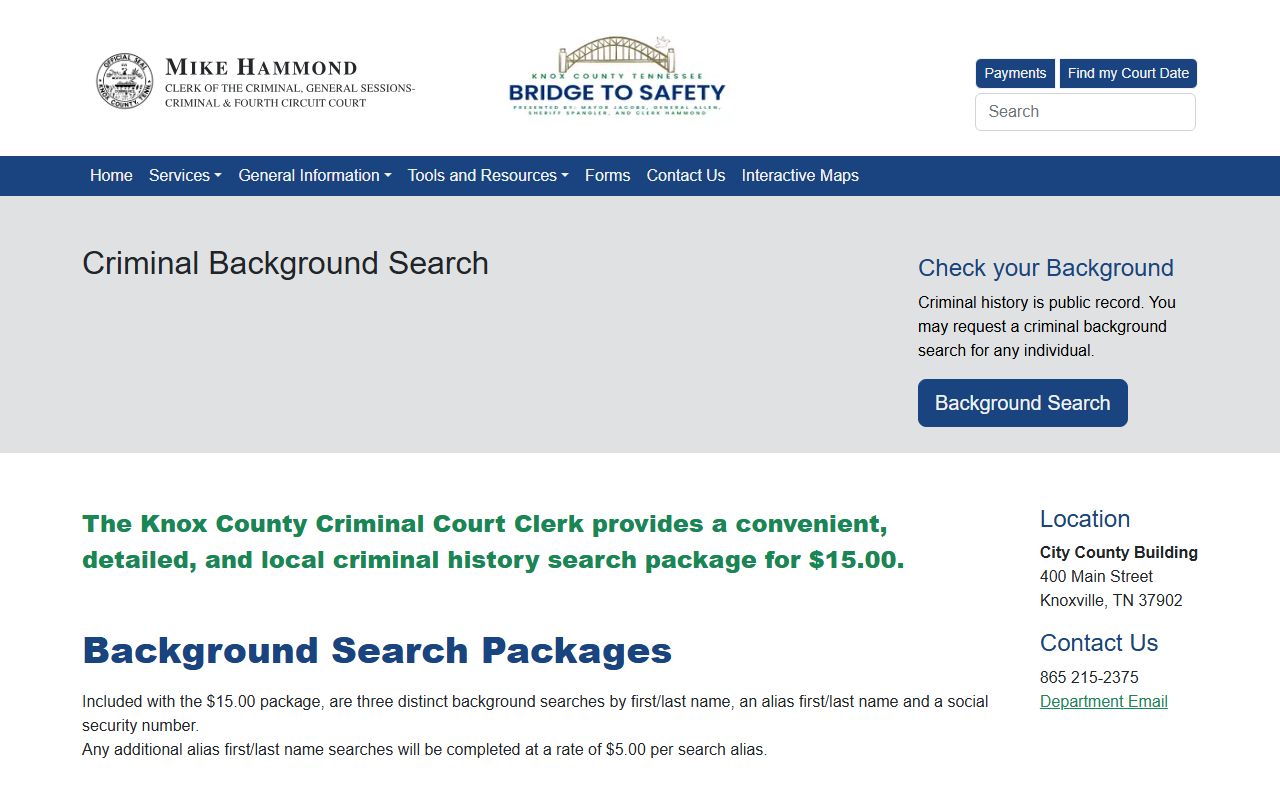
The background search service offers a local Knox County package, separate from a statewide check.
Civil, Family, and Criminal Divisions
Each court has a clear focus. Circuit Court hears general civil suits and appeals from lower courts. Fourth Circuit is the domestic court for divorces, orders of protection, and child custody. Criminal Court hears felony prosecutions in its three divisions. Chancery handles equity, probate, and child support resources.
The clerk split follows the courts. Mike Hammond's office covers Criminal, General Sessions-Criminal, and Fourth Circuit. Charles D. Susano III's office covers Circuit, Civil Sessions, and Juvenile. The Clerk and Master, J. Scott Griswold, handles Chancery. Court costs and fines run through the clerk's payment systems.
This split surprises many people. Fourth Circuit hears divorces and custody, yet its records sit with the Criminal Court Clerk, not a family clerk. Civil suits and small claims sit with the Circuit Court Clerk instead. Chancery, which handles probate and equity, has its own Clerk and Master who is appointed by the chancellors rather than elected. Knowing which clerk holds a file is the difference between a quick search and a wasted trip downtown.
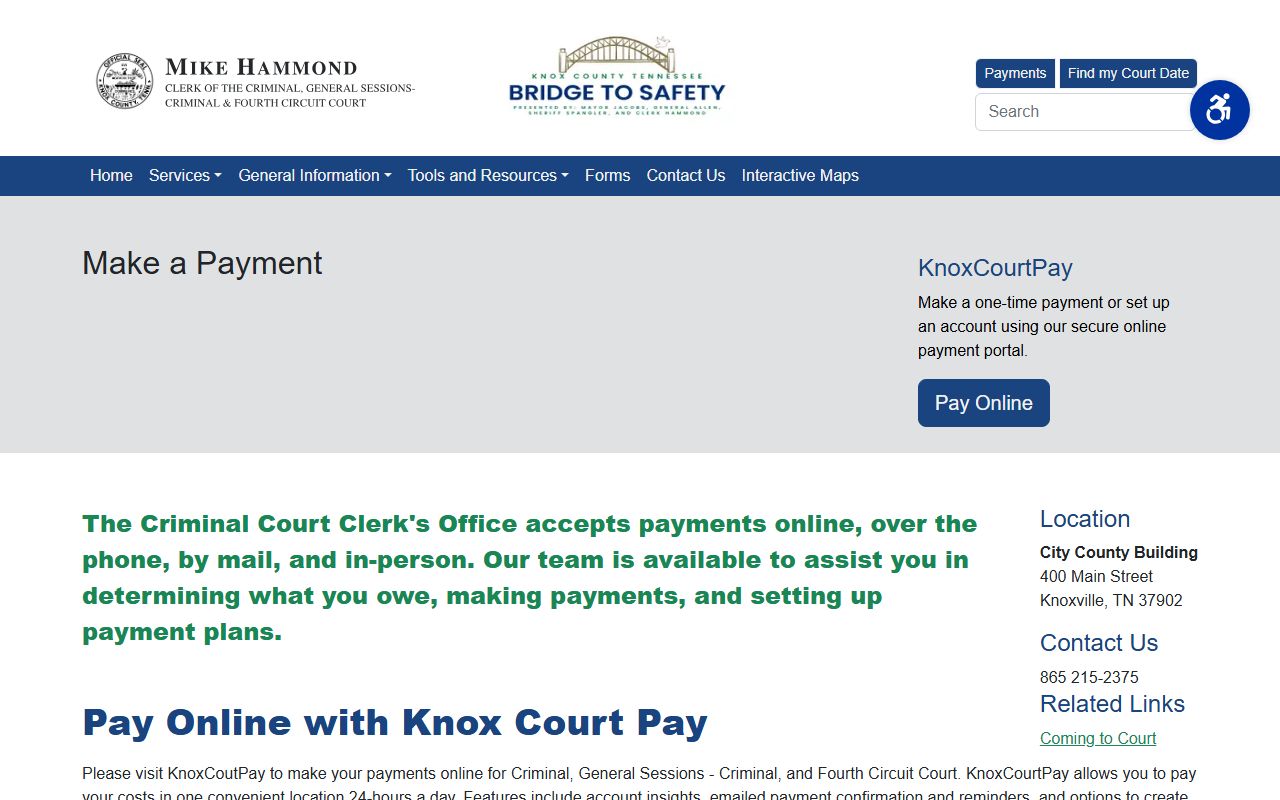
The payment options page covers online, phone, in-person, and mail payments for Criminal, General Sessions-Criminal, and Fourth Circuit.
The Sixth Judicial District
Knox County is the Sixth Judicial District of Tennessee. The District Attorney General for the district is Charme P. Allen, whose office represents the people of Tennessee in all criminal cases in Knox County. Five General Sessions judges rotate through the courts on a five-week schedule and are elected to eight-year terms. The General Sessions divisions are led by Judges Chuck Cerny, Judd Davis, Patricia Hall Long, Andrea Kline, and Tony W. Stansberry.
The District Attorney's office is large. It reports more than 40 assistant district attorneys, over 30 victim witness coordinators, several criminal investigators, and a set of special prosecution units, serving thousands of victims each year. The office motto is "Tough on Crime, Smart on Prevention," and the DA also takes part in courthouse security, mental health, and criminal justice committees. This scale is one reason Knox County runs several specialty courts alongside the regular criminal docket.
Magistrates and Lower Courts
Knox County has five magistrates appointed to set bonds, sign arrest warrants, and issue search warrants. A magistrate can be a Supreme Court justice, a Circuit or Criminal Court judge, a General Sessions judge, or a judicial commissioner. The standard a magistrate applies for a warrant is probable cause, meaning a higher probability than not that the person committed the crime. The same standard guides a judge at a preliminary hearing and a grand jury deciding whether a case proceeds to Criminal Court.
Below the state courts, the City of Knoxville runs a municipal City Court for city ordinance and many traffic matters, which is a separate limited-jurisdiction court with its own judge and fines. Because a Knoxville officer can write either a city ordinance citation or a state-law citation, the same stop can end up in City Court or in General Sessions depending on the charge.
Appeals from Knox County trial courts go to the Tennessee Court of Appeals for civil matters and the Tennessee Court of Criminal Appeals for criminal matters, with the Tennessee Supreme Court at the top.