
About the Knox County Clerk Offices
Three clerk offices hold Knox County court records, and each is led by a different official. Mike Hammond is the Criminal, General Sessions-Criminal, and Fourth Circuit Court Clerk. His office files, maintains, records, and preserves those court records. The office cannot give legal advice and cannot reset court dates, a limit it states plainly.
Charles D. Susano III is the Clerk of Circuit Court, Civil Sessions Court, and Juvenile Court. J. Scott Griswold is the Clerk and Master for Chancery Court, appointed by the chancellors rather than elected. A fourth office, the County Clerk under Sherry Witt, handles marriage licenses and county services but does not hold court case files.
One more office adds to the confusion. The Register of Deeds records real-property documents such as deeds and liens, and it is not a court clerk at all. So when people say "the clerk," they could mean any of five different Knox County offices. The safe habit is to name the court or the record type first, then ask which office holds it, rather than assume one clerk handles everything.
Criminal Court Clerk
Clerk: Mike Hammond
400 Main Street, Suite 149
Knoxville, TN 37902
865-215-2375
Mon-Fri 8:00 a.m.-4:30 p.m.
Circuit Court Clerk
Clerk: Charles D. Susano III
400 Main Street, Suite M30
Knoxville, TN 37902
865-215-2400
Mon-Fri 8:00 a.m.-4:30 p.m.
What the Clerks Do in Knox County
Each clerk office files documents, keeps the official case record, handles process, and collects court costs for its courts. The Criminal Court Clerk also runs community services. The Circuit Court Clerk supports civil filers, including a Civil Sessions Help Center. Juvenile records, held by the Circuit Court Clerk, are private under Tennessee law with few exceptions.
- File pleadings and keep the official court record.
- Issue and process court documents and subpoenas.
- Collect court costs, fines, and fees.
- Provide certified copies and records access.
The General Sessions judges, who hear cases the clerks support, are listed on the county's official page.
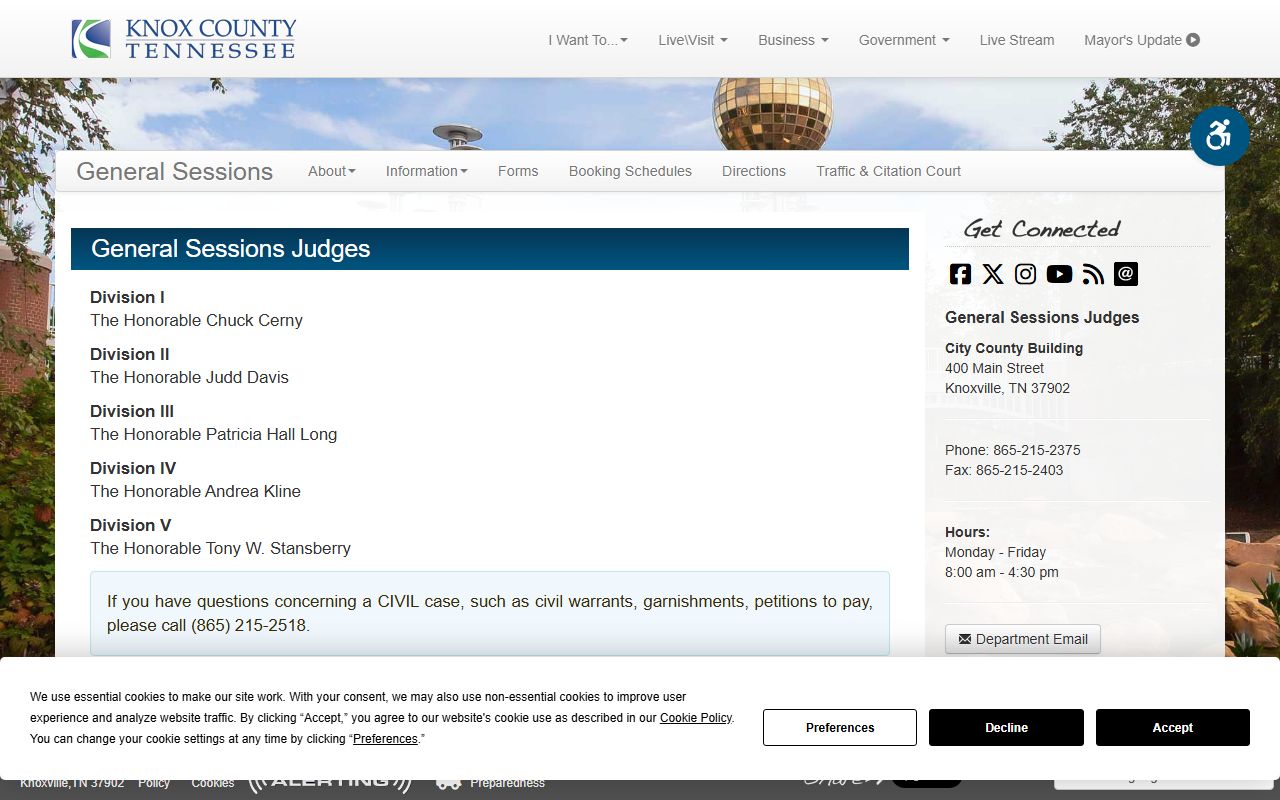
The General Sessions Judges page lists the divisions and explains criminal and civil contact guidance.
Inside the Criminal Court Clerk office, the work is divided among departments. Court Operations supports each courtroom with deputy clerks who keep records and carry out the judges' orders. A separate unit handles agency, attorney, and jail coordination, including subpoenas and data redaction. The Finance department collects court-ordered fines and fees and distributes money to crime victims or the proper agencies. Community Services and Jury Services round out the office, which has turned over millions in excess fees to the county through efficient operations.
How to Request a Certified Copy
A certified copy carries the clerk's seal and is the version courts and agencies accept as official. To get one, you need to know which court holds the case and have the docket number ready.
- Identify the court and the matching clerk office.
- Find the docket number, using JIMS or eCommerce if needed.
- Submit a request to the clerk with the case details and payment.
- Pick up the certified copy or wait for it by mail.
The Criminal Court Clerk also offers community services, including driver's-license reinstatement help, criminal background packages, and expungement screenings done with the District Attorney's office.
Each clerk handles only its own courts, so a certified copy request must go to the right office. A certified divorce decree comes from the Criminal Court Clerk, because that office holds Fourth Circuit records. A certified civil judgment comes from the Circuit Court Clerk. A certified probate order comes from the Clerk and Master. Sending the request to the wrong clerk only adds a delay, since one office cannot certify a record it does not keep.
Records Request Details
Whatever office you use, a records request goes faster when you give the clerk enough to find the file. The table lists what to include.
| Field | Required | Notes |
|---|---|---|
| Case or Docket Number | Helpful | Speeds the search; find it in JIMS if unknown. |
| Party Names | Yes | Full legal names of the parties. |
| Court | Yes | Criminal, Circuit, Fourth Circuit, or Chancery. |
| Document Type | Yes | Decree, judgment, full file, or specific filing. |
| Number of Copies | Yes | Certified or plain, and how many. |
Knox County Clerk Fees
Fees differ by office and service. The Criminal Court Clerk sells a local background package and adds a card service charge to online payments. Online civil records run on the KnoxCircuit subscription. Filing fees for Circuit, Civil Sessions, and Chancery changed on January 1, 2026 under Tenn. Code Ann. section 8-21-401, so use the official PDF schedules for line-item filing amounts.
| Item | Amount |
|---|---|
| Local criminal background package | $15.00 |
| Each additional alias search | $5.00 |
| KnoxCircuit Records (3 months) | $120.00 |
| KnoxCircuit Records (1 year) | $480.00 |
| Card payment service charge | 2.5% + $0.50 |
The Chancery fee schedule reflects the January 2026 change for equity and probate matters.
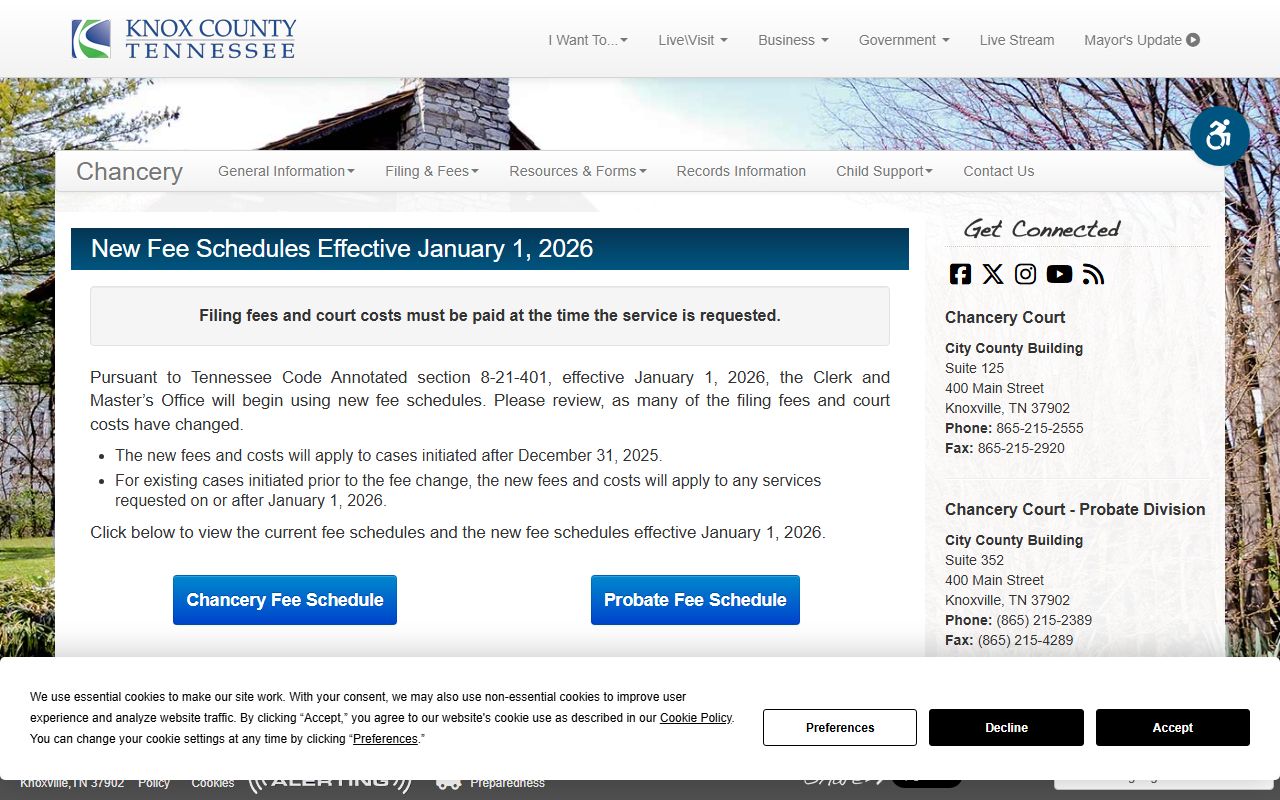
The Chancery fee schedule page posts the current amounts the Clerk and Master applies.
Common Clerk Pages and Forms
Each office posts its own resources online. The links below go to the most useful official pages for fees, juvenile filing, and judge contacts.
- Circuit fee schedule - Circuit and Civil Sessions costs.
- Juvenile Court page - contact, hours, and fax filing.
- KnoxCourtPay - online court cost payments.
Juvenile Court has its own building and filing rules, including fax filing under Tennessee Supreme Court Rule 5A.
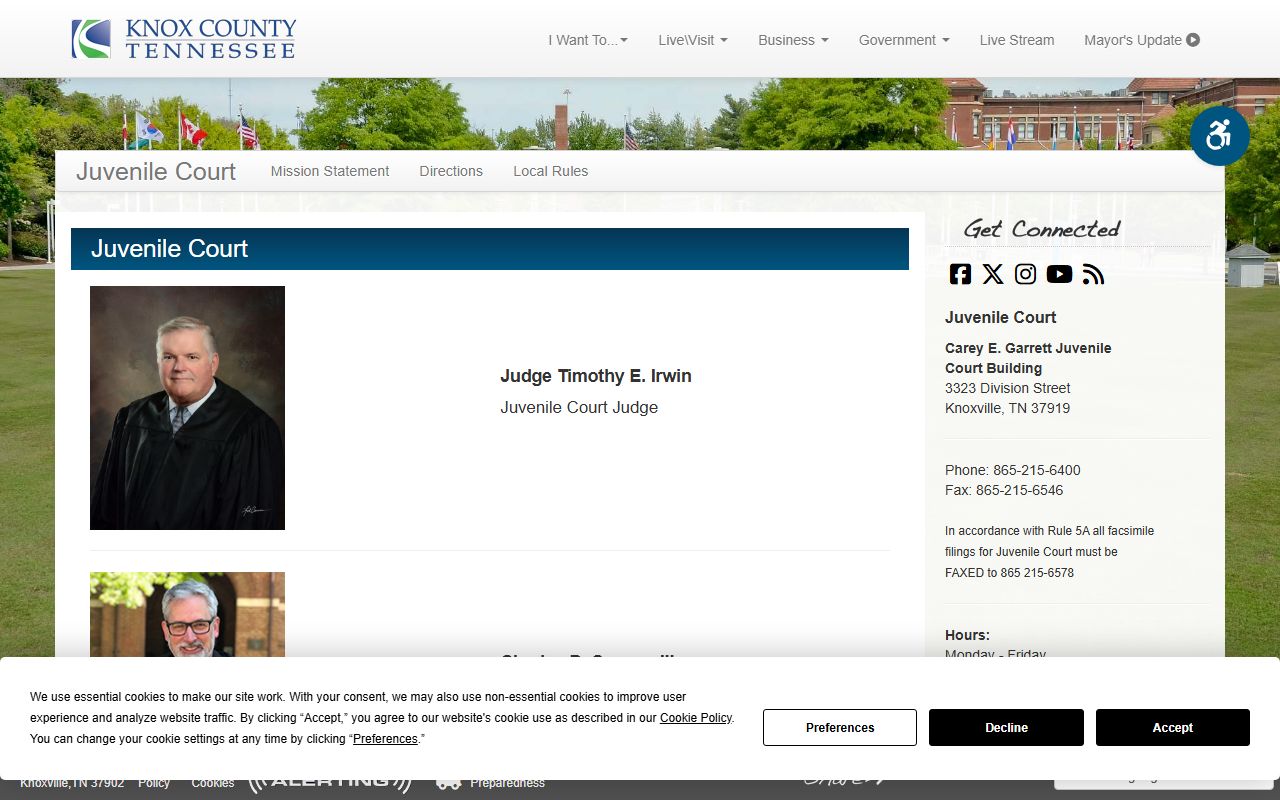
The Juvenile Court page lists the Carey E. Garrett building address, Judge Timothy E. Irwin, and clerk contact.
Mail and Online Filings
Online tools differ by court. The Criminal Court Clerk runs KnoxCourtPay for payments and offers a phone app and a "Find my Court Date" link. Fourth Circuit and General Sessions documents are searched in the Hyland eCommerce portal by docket number. Circuit and Civil Sessions filings are reviewed through the paid KnoxCircuit Records subscription. Mail payments go to court-specific addresses, with the defendant name and docket number on the check.
Because each clerk runs its own systems, confirm the right portal for your court before you file or pay. The wrong office cannot process a case it does not hold.
Payment routing is specific. The Criminal Court Clerk accepts online card payments, an automated phone line at 1-865-999-0817 that needs the case number and amount, in-person payment at the City-County Building, and mail. Criminal payments go to Suite 149, General Sessions-Criminal payments go to a P.O. box, and Fourth Circuit payments go to Suite M-15, with the defendant name and docket number on the check. A person who cannot pay in full can ask the clerk to set up a monthly cost agreement, but missing payments can lead to collection, a license hold, or garnishment.