
How to Search Knox County Court Records
The first thing to know is that Knox County court records are split by case type. Mike Hammond's office is the Criminal, General Sessions-Criminal, and Fourth Circuit Court Clerk, so criminal cases, misdemeanor and DUI matters, and divorces all run through it. Charles D. Susano III is Clerk of Circuit Court, Civil Sessions Court, and Juvenile Court. Chancery records sit with the Clerk and Master, J. Scott Griswold. Pick the right office and the search gets much easier.
For Fourth Circuit and General Sessions matters, the free OnBase Public/JIMS party search lets you look up a case by name. The Knox County JIMS party search is the tool to start with when you do not know a docket number. Once you have the number, you can pull documents through the eCommerce portal. Have a name, an approximate date, and a court type ready before you begin.
- Identify the case type and the court that holds it, then pick the matching clerk office.
- Open the JIMS party search and enter a last name, first name, or case title.
- Narrow by court type and the opened-after and opened-before date fields.
- Review the result rows for Court, Name, Role, Title, Opened date, and Docket number.
- Use the docket number in the Hyland eCommerce portal to find documents, or request a certified copy from the clerk.
The Knox County Court System landing page lists every court and office in one place, including Chancery, Circuit, Criminal, General Sessions, Civil Sessions, and Juvenile.
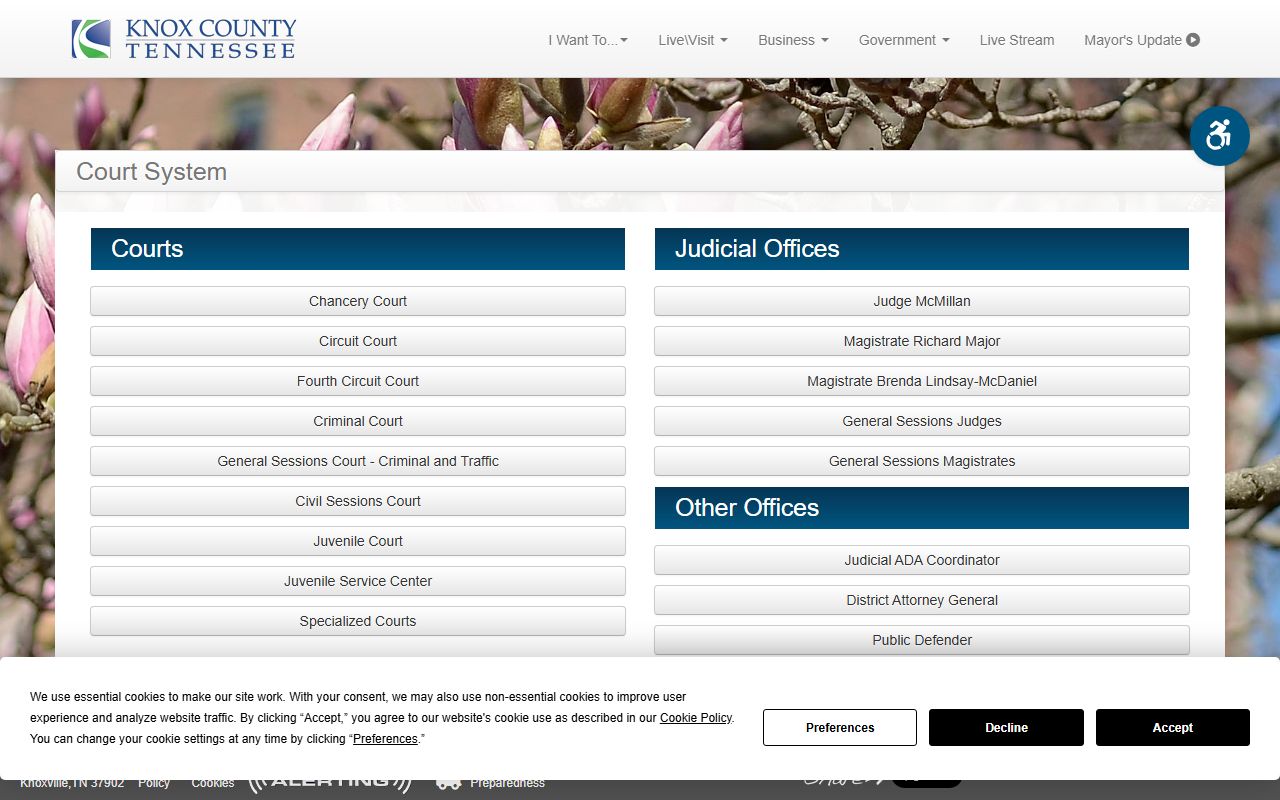
That single directory is the fastest way to confirm which Knox County court and clerk you need before you search.
Knox County Court Records Search Fields
The OnBase Public/JIMS party search is the main free portal for Fourth Circuit and General Sessions case records. Its help screen explains that last-name and first-name fields match any name that starts with what you type, so SMITH also returns SMITHERS and SMITHY. Case-title searches work the other way and match any title that contains the value. You need at least one name or title value to run a search.
| Field Label | Type | Required | Notes / Format |
|---|---|---|---|
| Last Name | Text | One name or title | Matches last names starting with the value. |
| First Name | Text | One name or title | Matches first names starting with the value. |
| Case Title | Text | One name or title | Matches any title that contains the value. |
| Role checkboxes | Checkbox | No | Limit to Attorney, Defendant, Plaintiff, or Judge. |
| In Court | Radio | No | All, Fourth Circuit, or General Sessions. |
| Opened After / Before | Date | No | Filters by filing date; check the default before you assume old cases are missing. |
Note: a single person can show up in several rows because each charge or related case has its own docket and title.
The Knox County Judicial System
Knox County sits in Tennessee's Sixth Judicial District. The Tennessee Constitution divides the state's 95 counties into judicial districts that include Circuit and Chancery Courts. Circuit Court is a court of general jurisdiction and can hear appeals from courts of limited jurisdiction. Criminal Court handles felony trials. General Sessions is where most criminal cases begin, and it splits into divisions for misdemeanors, DUI, felonies, traffic, and civil matters. Cases move up from there.
Five General Sessions judges rotate through the courts on a five-week schedule and are elected to eight-year terms. The District Attorney General for the Sixth Judicial District is Charme P. Allen. Appeals from state trial courts go to the Tennessee Court of Appeals for civil matters and the Tennessee Court of Criminal Appeals for criminal matters, with the Tennessee Supreme Court at the top.
Case flow: General Sessions Court › Circuit or Criminal Court › Court of Appeals or Court of Criminal Appeals › Tennessee Supreme Court
| Court | Jurisdiction | Case Types |
|---|---|---|
| General Sessions | Limited | Misdemeanors, DUI, felony preliminary matters, traffic, small claims under $25,000 |
| Circuit Court | General | Civil suits, appeals from lower courts |
| Criminal Court | General | Felony prosecutions, indictments, sentencing |
| Fourth Circuit | Domestic | Divorces, orders of protection, child custody |
| Chancery Court | Equity | Property disputes, probate, guardianship |
| Juvenile Court | Juvenile | Delinquency, dependency, unruly and family matters |
The Circuit Court Clerk page sets out this structure and names Charles D. Susano III as the clerk for Circuit, Civil Sessions, and Juvenile Court.
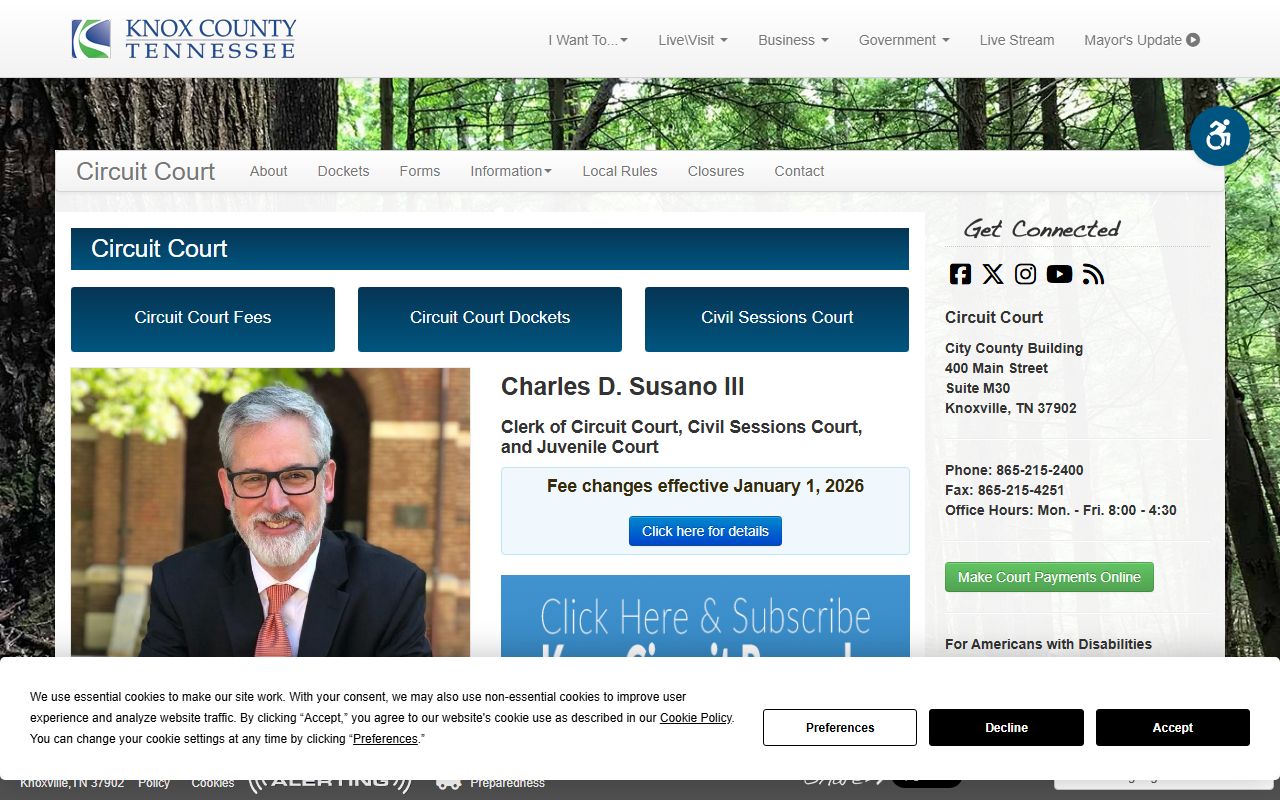
It also flags that, with few exceptions, juvenile records are private under Tennessee law.
Knox County Courthouses
Most court business in Knox County happens at the City-County Building at 400 Main Street in downtown Knoxville. That building holds the Criminal Court Clerk, Criminal Court and General Sessions-Criminal courtrooms, Fourth Circuit, Circuit Court clerk offices, Chancery Court, and the District Attorney General. The County Clerk who issues marriage licenses sits in the Old Courthouse a block away. Juvenile Court runs from a separate building on Division Street. Do not assume every Knox County record is in the same place.
Carey E. Garrett Juvenile Court
3323 Division Street
Knoxville, TN 37919
865-215-6400
Types of Court Records Available in Knox County
Knox County court records cover a wide range of cases. Criminal Court and General Sessions-Criminal records hold felony and misdemeanor matters and are kept by Mike Hammond's office. Fourth Circuit holds divorce and domestic files. Circuit and Civil Sessions hold civil suits and small claims. Chancery handles equity and probate work. Each record type is produced by a different court, which is why one search tool will not cover them all.
Here are the main kinds of records and where they come from.
- Criminal records - felony and misdemeanor cases from Criminal Court and General Sessions.
- Civil records - lawsuits and small claims from Circuit and Civil Sessions Court.
- Family and divorce records - divorces, custody, and orders of protection from Fourth Circuit.
- Probate records - wills, estates, and conservatorships through Chancery and the Clerk and Master.
- Traffic records - citations split between General Sessions and Knoxville City Court.
The Civil Sessions Court page covers small claims cases under $25,000 and points self-represented filers to a Help Center.
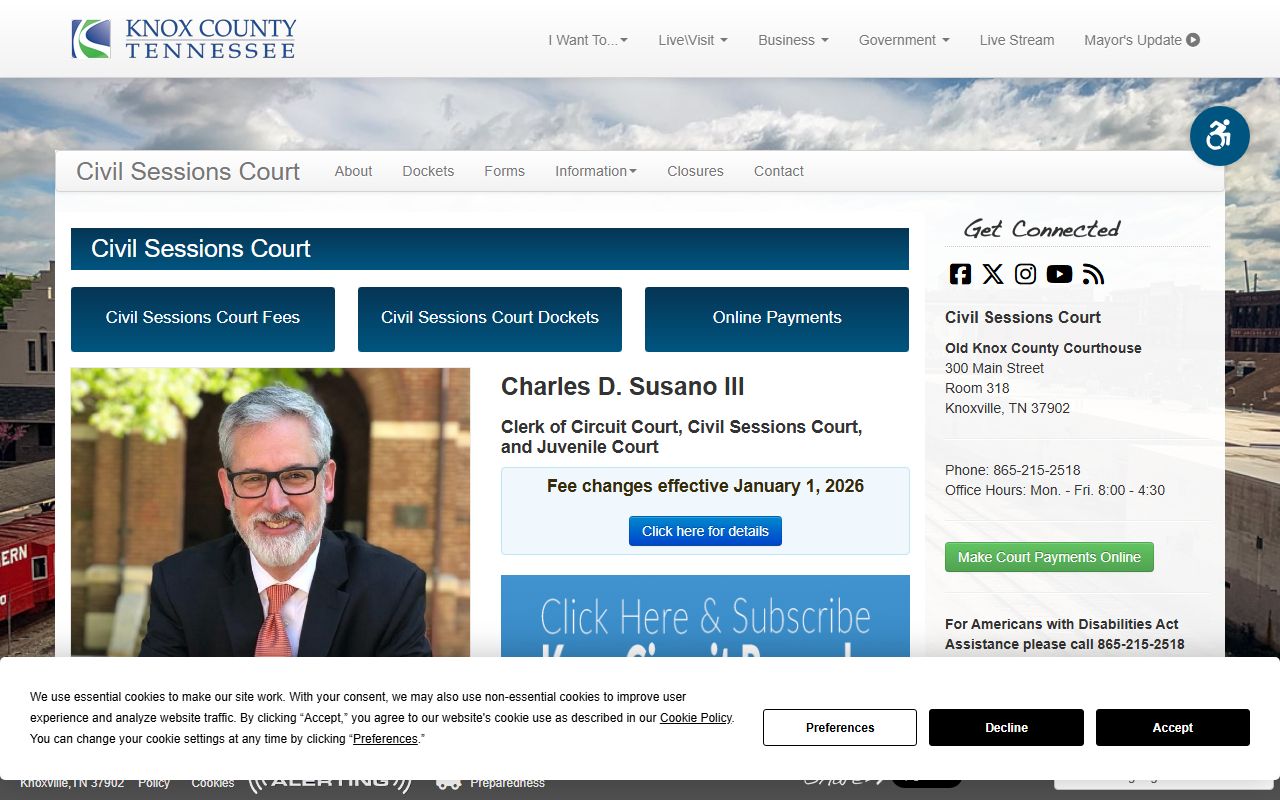
That Help Center is available online and at a kiosk on the third floor of the Old Courthouse.
What Knox County Court Records Show
A Knox County court record is built from a set of standard fields. In the JIMS party search, each result row shows the Court, the party Name, the Role, the case Title, the Opened date, and the Docket number. Inmate-linked court entries add a Court Date, Division, Court Event, and Court Role. Charge entries add a Document Type, a Booked or Served date, the Charge, a Bond Type, and a Bond Amount. Reading those fields tells you where a case stands.
| Field | What It Shows |
|---|---|
| Docket Number | The clerk's case identifier; formats vary by court. |
| Opened Date | When the case was filed or opened. |
| Parties and Role | Names plus role, such as Defendant or Lead Defendant. |
| Title / Charge | The charge description or case caption. |
| Court Event | The next step, such as preliminary hearing or status. |
| Disposition | The outcome of a charge or case. |
Public Access Laws for Knox County Court Records
Court records in Tennessee start from a broad right of access, but that right has limits. The Tennessee Public Records Act gives the public the right to inspect government records. Court files are governed more directly by a Supreme Court rule, which spells out what part of a case file is public and what is not. Do not assume every court record is open. Sealed orders, juvenile cases, and protective orders all carve out exceptions.
Key Statutes:
Tennessee Supreme Court Rule 34 - sets the public right to inspect court records unless a law, rule, or order makes them confidential.
Tenn. Code Ann. § 10-7-503 - the Public Records Act right to inspect records held by government agencies.
Tenn. Code Ann. § 40-32-101 - governs expungement and the removal of eligible criminal records.
Records That Are Restricted or Confidential
Several kinds of Knox County records are closed to the general public. Juvenile records are private under Tennessee law, with few exceptions. Adoption records are confidential and run through the Department of Children's Services. Sealed records and files under a protective order are off limits unless a judge says otherwise. Expunged records are removed once a court grants the order.
To view a sealed record, a party or attorney usually has to ask the court that holds it. The clerk cannot simply hand over a confidential file. If you believe you have a legal right to a restricted record, contact the clerk for the court where the case was filed or speak with an attorney about filing a motion.
Specialty Courts in Knox County
Knox County runs several problem-solving courts. The Criminal Court Clerk lists a Mental Health Court, a Recovery Court, and a Veterans Treatment Court. General Sessions Judge Chuck Cerny presides over misdemeanor and felony drug recovery courts and the Veterans Treatment Court. The Mental Health Court received Adult Mental Health Court Certification on January 7, 2025. Eligibility for these dockets is decided by the court, the prosecutor, and program rules, so a defendant should ask counsel or the court whether a program fits.
Knox County Sheriff and Jail
The Knox County Sheriff's Office, led by Sheriff Tom Spangler, runs the county's detention facilities. The main jail is the Roger D. Wilson Detention Facility at 5001 Maloneyville Road in Knoxville. The Sheriff publishes a current inmate population list and a 24-hour arrest list, both updated as a public service.
For custody status, booking details, and bond information, see the Knox County inmate records page. To learn about active warrants and the Criminal Warrants Unit, see warrant records. People released from custody can be tracked through the tools on the released inmates page.
Marriage, Divorce, and Probate Records
Marriage licenses are issued by the Knox County Clerk, Sherry Witt, not by the courts. Divorces are heard in Fourth Circuit Court, and those files run through the Criminal Court Clerk's office. Probate work, including wills and estates, goes through Chancery Court and the Clerk and Master. See the marriage and divorce records page and the probate records page for full details on each.
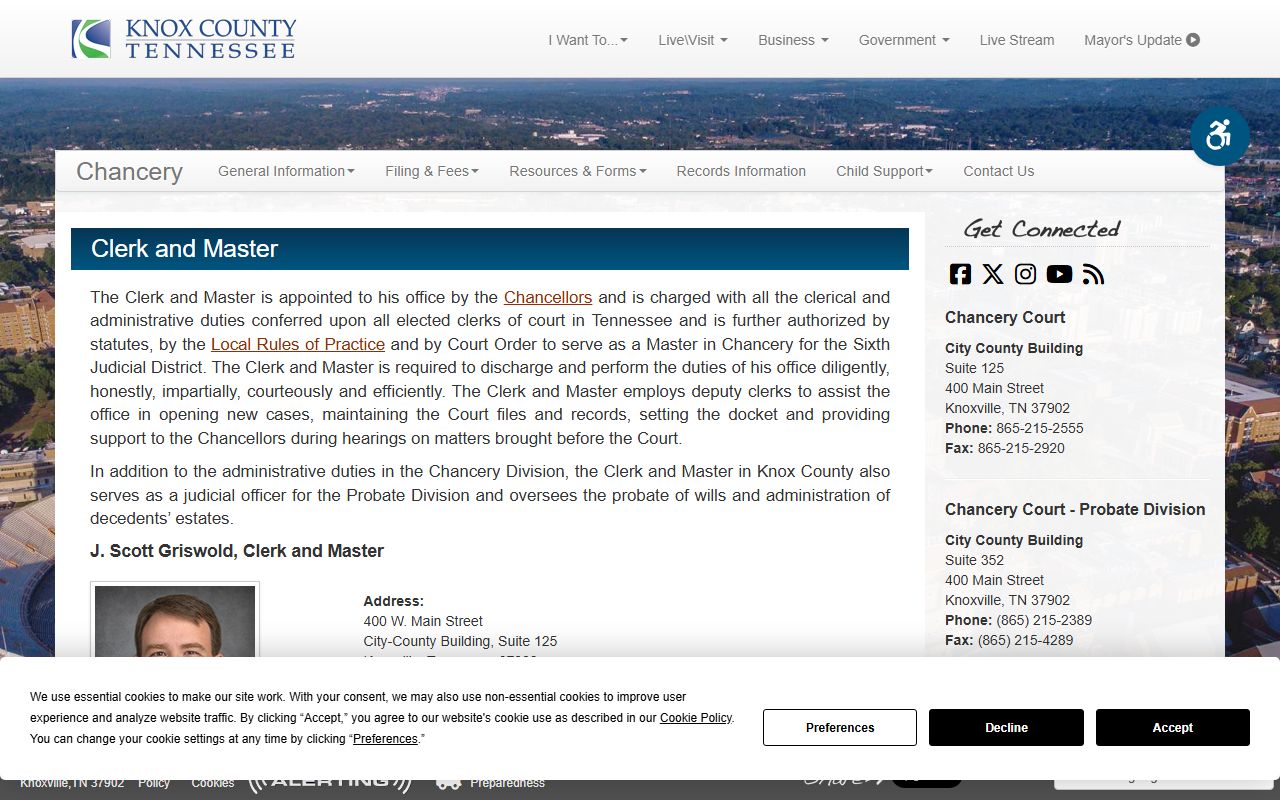
The Knox County Chancery Court page holds the filing, fee, and records information for probate-style matters.
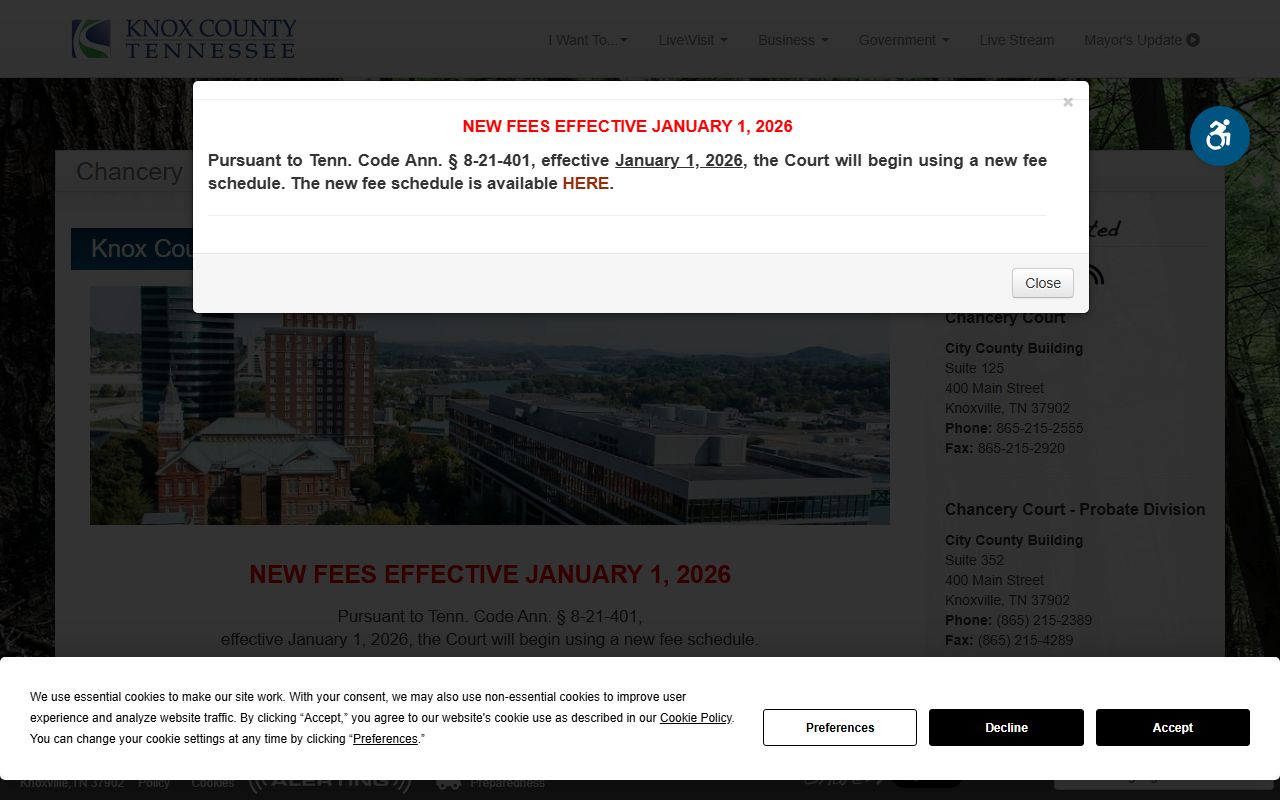
Chancery itself is staffed by the Clerk and Master, a role explained on the Clerk and Master page.
A few legal terms come up often in probate and estate files.
- Testator
- The person who made a will.
- Executor
- The person named to carry out a will.
- Conservator
- A person appointed to manage another adult's affairs.
Knox County Court Records Fees
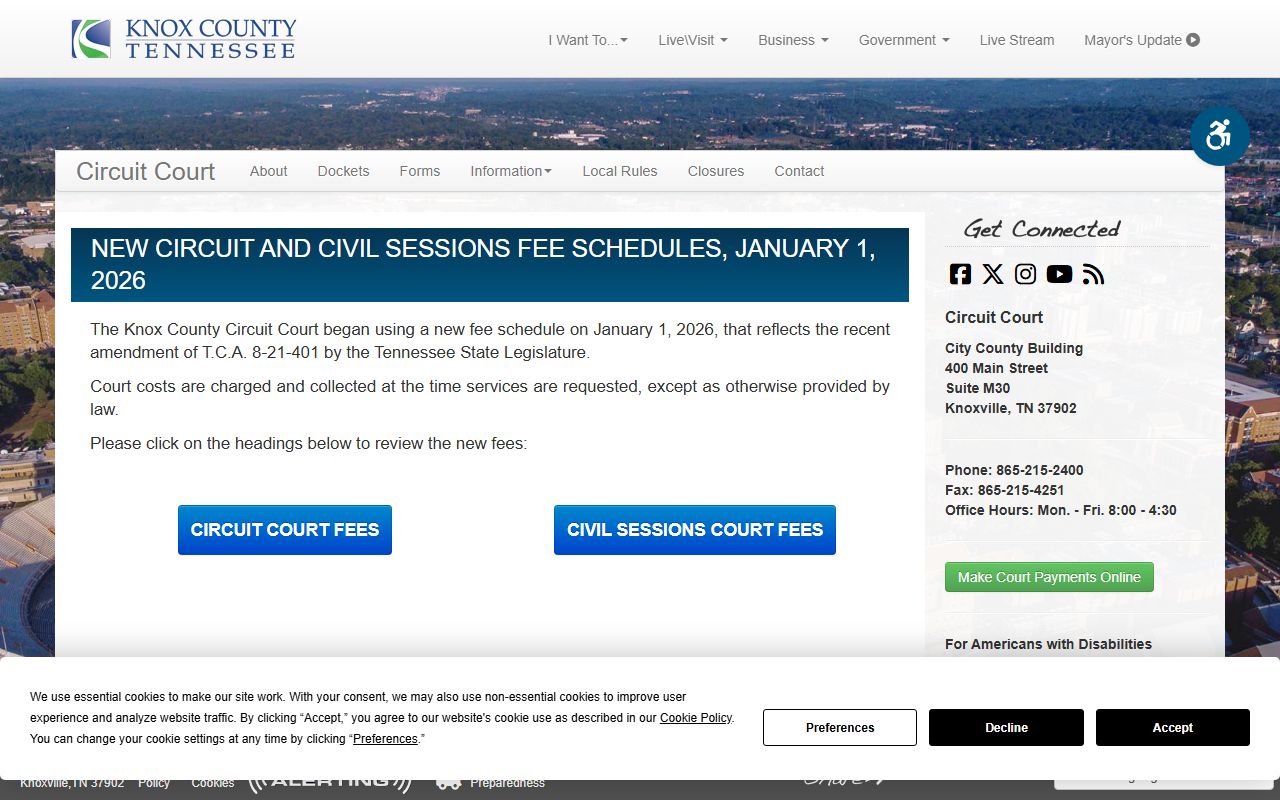
Fees depend on which office you use and what you ask for. The Criminal Court Clerk sells a local background package. Online access to Circuit and Civil Sessions filings runs on a paid subscription called KnoxCircuit Records. Certified marriage copies have a set fee at the County Clerk. Card payments add a service charge. Filing fees for Circuit, Civil Sessions, and Chancery changed on January 1, 2026 under Tenn. Code Ann. § 8-21-401, so check the official schedules for line items.
| Item | Amount |
|---|---|
| Local criminal background package | $15.00 |
| Each additional alias search | $5.00 |
| KnoxCircuit Records (3 months) | $120.00 |
| KnoxCircuit Records (1 year) | $480.00 |
| Certified marriage copy (in person) | $5.50 |
| Card payment service charge | 2.5% + $0.50 |
The Circuit and Civil Sessions fee schedule posts the current amounts in a PDF tied to the January 2026 change.
For online civil filings, the KnoxCircuit Records subscription covers Circuit records from April 14, 2015 and Civil Sessions from October 4, 2017.
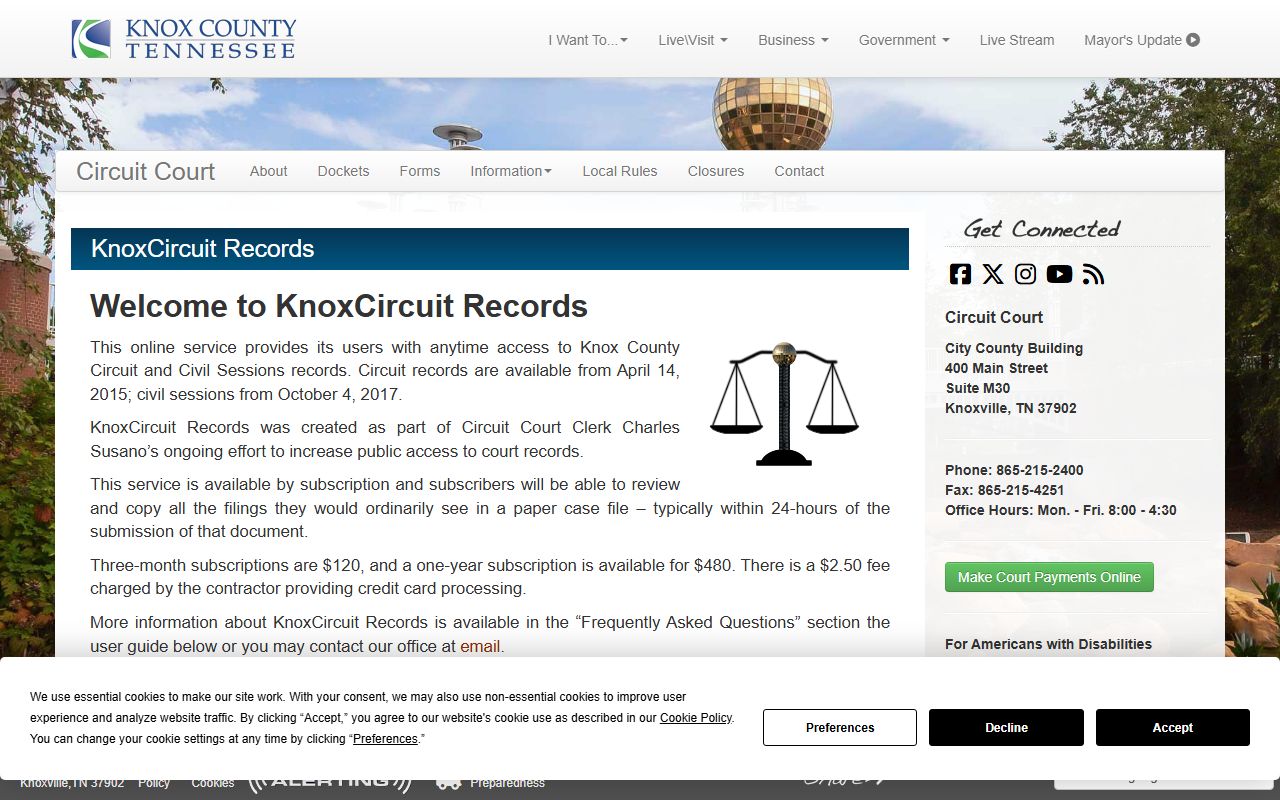
Subscribers can review and copy filings, usually within 24 hours of submission.
How to Interpret Knox County Court Records
Court files use shorthand that can confuse first-time readers. A charge is not the same as a conviction. The charge is what a person was accused of; the disposition is the outcome. On the inmate roster you may see VOP, which means a violation of probation, or a mittimus, which is a commitment order directing custody. A bench warrant often issues after a missed court date. Read the Court Event and Disposition fields before you draw a conclusion about a case.
Accuracy and Record Limitations
Online records are a convenience, not the final word. The Sheriff's Office states that its information should not be relied on for legal action and makes no warranty as to accuracy or timeliness. Court data can lag behind the paper file, and a name match is not proof of identity. When a record matters for a legal or safety decision, confirm it with the office that holds it.
Note: Always confirm a case detail with the clerk or office that created the record before you rely on what an online search shows.
History of Knox County Courts
The Old Knox County Courthouse at 300 Main Street is a listed historic landmark. The National Park Service records it as the Knox County Courthouse, National Register ID 73001803, listed on April 24, 1973, with a significant year of 1885 and architects Stephenson and Getaz. The County Clerk still uses the Old Courthouse as a main public office today. The modern City-County Building at 400 Main Street is now the working home of Criminal, Circuit, Fourth Circuit, Chancery, and General Sessions courts.
The Knox County government homepage links to every department and court office described here.

It is the single best starting point when you are not sure which Knox County office to call.
Frequently Asked Questions
Where do I search Knox County court records?
Start with the case type. General Sessions and Fourth Circuit party searches use the OnBase Public/JIMS tool. Documents for those courts can be pulled by docket number in the Hyland eCommerce portal. Circuit and Civil Sessions filings are in KnoxCircuit Records by subscription, and Chancery records go through the Clerk and Master. There is no single search box for every court.
Who is the Knox County Criminal Court Clerk?
Mike Hammond is the Criminal, General Sessions-Criminal, and Fourth Circuit Court Clerk. His office is at the City-County Building, 400 Main Street, Suite 149, Knoxville, TN 37902. The phone is 865-215-2375 and hours are Monday through Friday, 8:00 a.m. to 4:30 p.m. The office cannot give legal advice or reset court dates.
Is there a warrant search?
No public active-warrant name search was found for Knox County. The Sheriff's Criminal Warrants Unit accepts tips and lists a LEIDS contact at 865-215-2442. If you think you have a warrant, the safest path is to call an attorney or the relevant court clerk rather than rely on an unofficial site.
More on the Knox County Court Records FAQ page.